
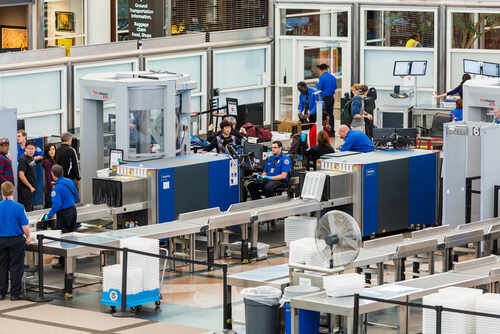
After six weeks of a partial DHS shutdown, President Trump is pulling fully funded ICE agents into airports to keep security lines from collapsing into chaos.
Quick Take
- President Trump announced ICE agents will deploy to some U.S. airports starting Monday to help overwhelmed TSA checkpoints during a partial DHS shutdown.
- DHS says “hundreds” of ICE officers will assist with crowd control, line management, and guarding terminal entry/exit points—not X-ray screening—because ICE lacks aviation security training.
- Atlanta officials confirmed ICE presence at Hartsfield-Jackson for non-enforcement support, aiming to reduce fear that travelers will face immigration checks at checkpoints.
- TSA’s union and Democrats warn the plan risks confusion and security gaps, while the White House frames it as a practical workaround to staffing shortages and unpaid TSA labor.
Why ICE Is Showing Up at Airports Now
President Trump said ICE agents will begin reporting to “adversely impacted airports” on Monday, March 23, after hours-long TSA lines spread nationwide during a partial Department of Homeland Security shutdown that has stretched into its sixth week. DHS said the agency plans to send “hundreds” of ICE officers to assist at airports where delays are most severe. The immediate mission is operational: stabilize lines and reduce bottlenecks while TSA staffing remains strained.
The shutdown backdrop matters because it reveals an internal imbalance inside DHS: some components are struggling to operate while others remain fully funded. Reporting cited that Congress’ 2025 funding package, the “One Big Beautiful Bill Act,” directed billions toward ICE, while TSA and other DHS components faced furlough pressure and unpaid work during the current funding lapse. With TSA stretched thin, the administration is shifting available personnel to manage crowds and maintain basic order in terminals.
What ICE Officers Will—and Won’t—Do in Terminals
DHS and administration officials emphasized that ICE officers are not being inserted as substitute screeners. The plan assigns ICE to tasks like line management, crowd control, and guarding entry and exit points around terminals—work that can free TSA officers to focus on screening passengers and bags. White House border czar Tom Homan described the operation as a “work in progress,” with ongoing coordination between ICE and TSA leadership as airports prepare for the deployment.
That limitation is central to the debate because aviation screening is a specialized job with extensive training requirements. Everett Kelley, president of the American Federation of Government Employees, said ICE agents are not trained or certified in aviation security, underscoring that TSA roles involve identifying prohibited items and responding to threats in an airport environment. DHS messaging aligns with that concern by drawing a hard line: ICE will support the flow and perimeter, not operate X-ray machines or conduct specialized screening.
Political Blowback and Overheated Rhetoric
Democrats attacked the proposal, framing it as reckless and potentially dangerous. House Minority Leader Hakeem Jeffries argued that deploying untrained ICE agents could put travelers at risk, using extreme language that drew attention in coverage. The strongest claims here are political assertions, not supported with specific operational evidence in the reporting. What is documented is the training gap: critics have a concrete point on certification and aviation procedures, even if some of the rhetoric goes far beyond established facts.
Civil-liberties groups also objected. The ACLU issued a statement criticizing the administration’s plans, reflecting broader concerns that mixing immigration enforcement with airport operations can chill lawful travel and raise fears of profiling or mission creep. At the same time, available reporting indicates the stated airport roles are support functions, and at least one major airport made a public point of separating crowd-control duties from immigration enforcement to reduce panic among travelers.
Atlanta’s Test Case—and the Enforcement Question
Atlanta became an early focal point after Mayor Andre Dickens confirmed ICE agents were at Hartsfield-Jackson Atlanta International Airport to help manage lines and crowds, explicitly stating the work was not immigration enforcement. That local clarification is important because many Americans associate ICE with arrests and removals, not airport customer-flow assistance. When families are trying to make flights, even the perception of enforcement activity can trigger confusion, delays, and public confrontation inside already stressed terminals.
ICE agents deployed to some U.S. airports as TSA lines stretch for hourshttps://t.co/tGh2U3In2X
— SCMcGee Never Give Up On Hope (@McGee06708992) March 23, 2026
The remaining unanswered question is how consistently that separation can be maintained nationwide. Homan has said ICE agents would continue immigration enforcement as part of their broader duties, while local statements like Atlanta’s describe a non-enforcement assignment in the airport setting. The reporting does not provide a finalized list of airports, exact staffing totals beyond “hundreds,” or a standardized national protocol that clearly defines when an ICE officer in a terminal may shift from crowd-control support to enforcement activity.
Sources:
ICE officers set to deploy to airports as delays mount, border czar Homan confirms
ICE agents to be deployed to US airports beginning Monday
ICE agents to be deployed to US airports beginning Monday
ACLU statement on Trump administration plans to deploy ICE to airport security lines