

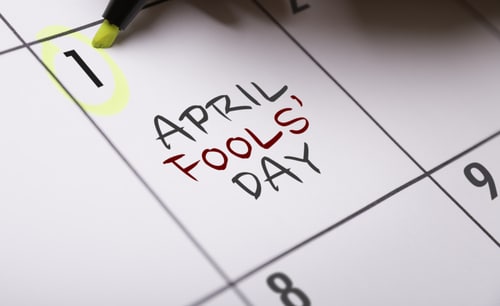

April Fools’ Day, also known as All Fools’ Day, is a day of practical jokes, hoaxes, and pranks. It is celebrated annually on the first of April. But where did this tradition come from?
The origins of April Fools’ Day are somewhat unclear. One theory suggests that it dates back to ancient Rome, where people would celebrate Hilaria, a festival held in honor of Cybele, the mother of the gods. This festival involved masquerades and people playing pranks on each other.
Another theory suggests that April Fools’ Day is linked to the adoption of the Gregorian calendar in the 16th century. Before this, New Year’s Day was celebrated on April 1st. When the new calendar was adopted, moving New Year’s Day to January 1st, some people continued to celebrate it on April 1st, and were subsequently ridiculed by those who had embraced the new calendar.
In France, April Fools’ Day is known as Poisson d’Avril, which translates to “April Fish.” It is said that in the 16th century, King Charles IX changed the calendar to the Gregorian calendar, but some people continued to use the old Julian calendar. These people were mocked and tricked by others who would offer them fake fish on April 1st, as a reference to the fact that the old calendar celebrated New Year’s Day around the time of the spring equinox, when fish were abundant.
Regardless of its origins, April Fools’ Day has become a popular tradition across the world, with people playing pranks on their friends, family, and colleagues. Some of the most famous April Fools’ Day pranks include the BBC’s 1957 broadcast of a spaghetti tree, which convinced people that spaghetti grew on trees, and Google’s 2014 announcement of a Pokémon challenge, where users could search for Pokémon on Google Maps.
Although it may seem like a trivial tradition, April Fools’ Day has had significant cultural and political impact throughout history. In 1708, an April Fools’ Day prank led to the printing of the first newspaper cartoon in England, and in 1962, a spoof article in a Swedish newspaper caused panic and confusion when it claimed that switching to driving on the right-hand side of the road was mandatory.
Overall, April Fools’ Day is a day of lighthearted pranks and jokes, but its history is deeply rooted in cultural and political traditions. It serves as a reminder that laughter and humor can be powerful tools for bringing people together, and for challenging the status quo.