A deadly skydiving crash in France has left 11 people dead and raised fresh questions about how authorities handle “unknown cause” tragedies in a world where many already feel the system protects elites more than ordinary people.
Story Snapshot
- Eleven people died when a skydiving plane crashed near homes and a shopping area in Tomblaine, France.[1][5]
- Officials say a “malfunction” caused the almost vertical plunge, but the exact cause is still under technical investigation.[1][5]
- Police blocked off the crash site, urged the public to stay away, and began gathering witness statements.[2][5]
- Limited information and talk of an “unexplained” crash are already feeding public suspicion and fear.[2][7]
What Happened In The Tomblaine Skydiving Crash
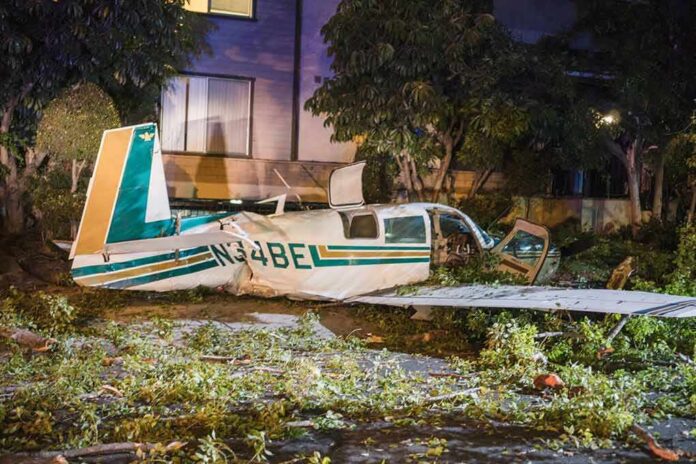
On Sunday, June 28, a small tourist plane carrying skydivers took off from Nancy-Essey airfield in northeastern France and crashed minutes later near the town of Tomblaine.[1][5] All 11 people on board died: the pilot, five skydiving students, and five instructors, according to regional officials.[1][5] The aircraft, a German-registered Pilatus Turbo Porter used by a parachuting school, went down close to homes, a bike path, and a shopping area, but no one on the ground was hurt.[1][3]
Regional prefect Yves Séguy told reporters the plane appeared to fall “almost vertically” soon after takeoff and that officials believe a malfunction triggered the crash.[1][5] He added that there was no sign of an attempted emergency landing and that people in the nearby residential area were “fortunate” not to be injured.[1] At the same time, he admitted that the crash remains “unexplained” and that authorities do not yet know exactly what went wrong in those final seconds.[2]
How French Authorities Say They Are Investigating
Deputy public prosecutor Amaury Lacote from Nancy confirmed that a formal technical investigation has begun to find the cause of the accident.[1] That probe is expected to follow standard aviation methods: secure the crash site, collect wreckage, recover any recorders, and review maintenance logs and pilot records before naming a probable cause.[10][11] Emergency services have started interviewing witnesses, including people who saw the aircraft appear to “have issues” before it suddenly descended.[2][5]
Police set up a wide perimeter around the crash zone and urged residents, through social media and local posts, to stay away from Rue Salvador Allende to keep roads clear for emergency crews and investigators.[1][3] This type of lockdown around a crash site is routine in aviation cases, but it also means locals and families must wait for updates while specialists work behind fences and tape.[10] As of now, officials have not released any detailed findings, such as engine inspection results or data from flight recorders, adding to the sense of uncertainty.[1][5]
Why “Unknown Cause” Fuels Public Distrust
Local leaders, including the mayor of Tomblaine, have said the plane seemed to fall from the sky “in a completely unexplained manner” and that it is too early to give firm answers.[2] For many people, especially in a time when faith in government is low, phrases like “malfunction” and “unexplained” sound vague and unsatisfying. When eleven people die near a busy shopping area, families and neighbors want clear facts, not just reassurances that experts are handling things behind closed doors.[1][7]
11 Dead in Tragic Skydiving Plane Crash in Tomblaine, France 🇫🇷✈️
A devastating light aircraft crash in northeastern France yesterday has been confirmed as the country's deadliest skydiving-related air disaster in history. pic.twitter.com/nwnHaiSvLY— Aviation (@Onyeabuo) June 29, 2026
That gap between what officials know and what they share is where distrust grows. In recent years, aviation investigations have often started with weeks or months of official silence while technical teams work through complex data.[10][11] Here, the local prosecutor’s office has declined to give more detail to reporters so far.[5] In a world where many citizens on both the right and the left suspect “elites” and institutions of hiding mistakes, that silence can easily be read as stonewalling rather than careful procedure.
Witness Accounts, Social Media, And The Search For Truth
Beyond official statements, at least one social media post claims a witness saw the plane at about 2,000 feet with one propeller stopped before the crash.[9] If accurate, that could point to a serious mechanical failure. However, this account has not yet been backed up by forensic evidence or included in any formal briefing, so it remains anecdotal. Without engine teardown reports or data from cockpit voice and flight recorders, no one outside the investigation team can say whether such a failure occurred.
Police have used platforms like X to push crowd-control messages, telling people to stay away from the site.[4][5] At the same time, many citizens turn to those same platforms for raw witness videos and alternative explanations. When only some voices are amplified and official channels stay sparse, it feeds the feeling that regular people must do their own digging because institutions cannot be trusted. That tone matches broader frustration in many countries, including the United States, where people on both left and right see a system that responds faster to liability and image problems than to public questions.
Skydiving Safety And Systemic Questions
Parachute and skydiving flights have long raised safety concerns, even before this French crash.[9] Past investigations, including work by the United States National Transportation Safety Board, have highlighted recurring risks around maintenance, pilot training, and pressure to keep commercial jump operations running on tight budgets.[9] While there is no confirmed negligence yet in the Tomblaine case, the fact that a commercial parachute school was involved means any finding of fault could carry serious financial consequences for the operator.[4]
When money, liability, and reputation are on the line, many citizens worry that investigations might slow-walk or soften harsh truths. That fear is not proof of a cover-up, but it explains why official talk of “malfunctions” and “unknown causes” no longer calms the public like it might have decades ago. For families of the 11 victims, and for residents who watched a plane fall near their homes, the key test will be whether French investigators release clear, complete findings and show that every possible cause—from mechanical failure to human error—was examined without favor.[10][11]
Sources:
[1] YouTube – Light aircraft crashes in eastern France, officials say eleven killed
[2] Web – Plane Crash Near Nancy Kills All 11 On Board in Eastern France
[3] Web – Skydiving plane crash in northeastern France kills 11 near Nancy
[4] Web – Civilian plane crash kills 11 in France – Global News
[5] Web – Skydiving plane crashes in eastern France, killing all 11 on board
[7] Web – Eleven people have died in a plane crash near Nancy in eastern …
[9] Web – The crash reportedly happened on an airstrip near the western coast …
[10] Web – Two killed as light aircraft crashes in north France
[11] Web – France: 11 killed in civilian plane crash – Yahoo News UK