

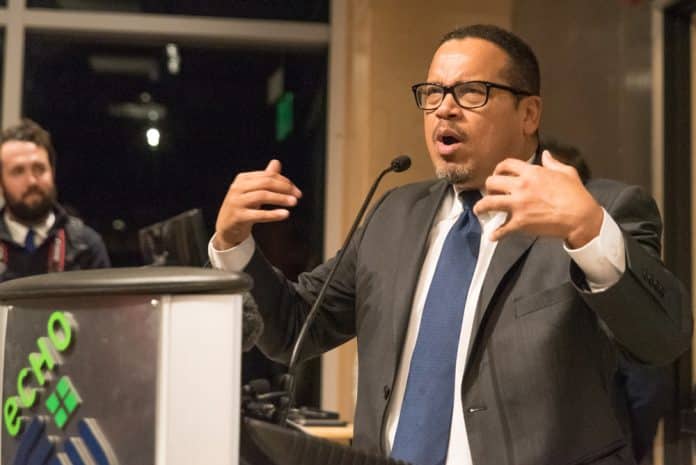

ICE SURGE Ends Amidst Political Firestorm
Minnesota’s top lawyer went to the U.S. Senate and suggested deporting illegal immigrants “depends”—even as federal authorities moved to end an ICE surge that his office sued to stop.
Story Snapshot
- Minnesota Attorney General Keith Ellison defended his state’s resistance to “Operation Metro Surge” while testifying before a Senate Homeland Security panel.
- Ellison described past ICE cooperation as “legal and cooperative,” but argued the surge represented a dramatic escalation that harmed communities.
- Federal authorities announced the end of the Metro Surge around the time of Ellison’s testimony, after weeks of legal and political conflict.
- A federal judge denied Minnesota’s request for an early injunction, while acknowledging serious, “heartbreaking” alleged impacts tied to the operation.
Senate testimony spotlights a deeper dispute over enforcement
Keith Ellison’s appearance before the Senate Homeland Security panel put a spotlight on a basic question voters have asked for years: should immigration laws be enforced consistently, or selectively. In tense exchanges, senators pressed Ellison on whether Minnesota would cooperate with the removal of illegal immigrants, especially those accused of crimes. Ellison emphasized oversight concerns and said Minnesota opposed the surge as conducted, not routine law enforcement cooperation.
The available reporting does not provide a single clean, verbatim quote confirming the exact phrase “it depends,” but multiple summaries describe Ellison taking a conditional posture—supporting certain cooperation while rejecting broad or aggressive actions tied to the surge. That nuance matters. For law-and-order voters, conditional enforcement can sound like a political escape hatch. For civil-liberties advocates, Ellison’s emphasis on oversight frames the question as how enforcement is carried out.
Keith Ellison Says ‘It Depends’ Whether an Illegal Immigrant Should Be Deported https://t.co/QvynUOkNnJ
— Marlon East Of The Pecos (@Darksideleader2) February 12, 2026
What “Operation Metro Surge” was—and why Minnesota sued
On January 12, 2026, Ellison joined Minneapolis and Saint Paul in a federal lawsuit against DHS and ICE over Operation Metro Surge, arguing it violated the First and Tenth Amendments and other legal principles. Minnesota’s filings and public statements described the surge as unusually large and disruptive for a state that ranks low in immigrant population. The lawsuit also framed the operation as improper federal pressure on a politically hostile state.
On January 31, a federal court denied the request for a preliminary injunction, which meant the surge could continue while the case proceeds. Still, the court noted the allegations described “profound and heartbreaking” impacts. That mixed ruling—no immediate block, but a warning about claimed harms—left both sides claiming partial vindication. Ellison vowed to keep fighting in court, while federal officials continued arguing that enforcement targeted criminal illegal aliens.
Deaths, community disruption, and the limits of the public record
Ellison and allied local officials pointed to reports of shootings and deaths connected to ICE activity, including the cases of Renee Good and Alex Pretti, as evidence the surge had “gone too far.” Ellison urged increased accountability steps such as access to facilities and outside investigation, and he criticized masked or aggressive tactics in public descriptions of enforcement. Key details about those investigations remain unclear in the available sources, including what federal agencies have formally confirmed.
Local impacts cited in the reporting included fear in immigrant communities, school absenteeism, business disruption, and strained local public safety resources. Those claims are difficult to quantify without independent data released publicly, and the court record referenced in state communications is largely presented through Minnesota’s lens. At the same time, the Trump administration’s rationale centered on enforcement and public safety, with officials emphasizing removal of dangerous criminals and seeking state and local cooperation on detainers.
Surge ends amid political pressure, but the constitutional clash continues
Federal authorities announced the end of the Minnesota immigration crackdown around February 12, 2026, as Ellison testified and senators questioned both the operation’s effects and state cooperation. Separate reporting also ties the wind-down to discussions involving White House Border Czar Tom Homan, who met with Ellison on January 29. Ending the surge reduces immediate disruption, but it does not end the underlying dispute over federal power versus state pushback.
For conservatives focused on sovereignty and equal application of the law, the takeaway is straightforward: when state leaders signal that deportation “depends,” enforcement predictably becomes inconsistent—especially in sanctuary-style environments where detainer cooperation is contested. For constitutional conservatives, the other takeaway is that federal power must still be exercised with discipline and transparency, because heavy-handed tactics create openings for lawsuits, court scrutiny, and public backlash that can undermine long-term enforcement goals.
Sources:
https://www.ag.state.mn.us/Office/Communications/2026/01/31_ICE-Surge.asp
https://forumtogether.org/article/legislative-bulletin-friday-january-16-2026/
https://www.cbsnews.com/live-updates/minnesota-immigration-ice-hearing-senate-homeland-security/
https://affordingyourlife.substack.com/p/statement-from-ag-ellison-on-meeting
https://www.ag.state.mn.us/Office/Communications/2026/01/29_Homan.asp
https://www.house.mn.gov/Caucus/View/GOP/51527