

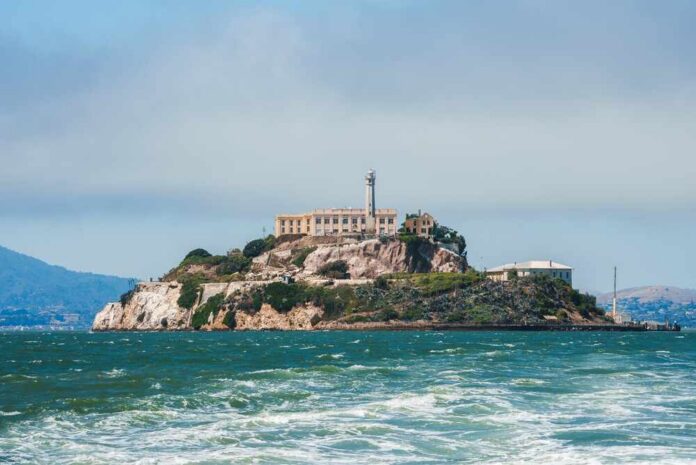
Trump’s push to pour $152 million into reopening Alcatraz is turning a famous National Park tourist magnet into a Washington spending fight over what “law and order” should actually cost taxpayers.
Story Snapshot
- The White House’s 2027 budget request seeks $152 million for year one of a plan to reopen Alcatraz as a federal prison, with total costs estimated by some reports at roughly $2 billion.
- The administration says the revived prison would house “America’s most ruthless and violent offenders,” while officials have also discussed detaining “criminal illegals.”
- The Bureau of Prisons says it is conducting a “rigorous evaluation” and argues modern engineering could make the project feasible, despite the island’s history of extreme operating costs.
- Democratic leaders and San Francisco officials call the idea unrealistic and wasteful, warning it would replace a public historic site that brings in major tourism revenue.
$152 Million Up Front, and Congress Holds the Keys
The White House’s 2027 budget proposal requests $152 million to begin reopening Alcatraz as a federal prison, reviving a facility that closed in 1963 largely due to high costs and deteriorating infrastructure. The administration’s pitch focuses on incapacitating the nation’s most violent criminals, but the first-year ask comes amid broader estimates that a full rebuild could run into the billions. Congress must approve the funding, meaning the plan will rise or fall in a familiar budget showdown.
President Trump first put the idea on the table in May 2025, directing the Bureau of Prisons and federal law-enforcement agencies to pursue reopening and expansion. Since then, the process has moved from slogan to site visits and early-stage assessments. The practical reality is that Alcatraz is not an empty federal lot waiting for construction; it is a National Park Service-managed historic landmark in San Francisco Bay, with public access and existing tourism operations.
Feasibility Studies vs. the Island’s Hard Constraints
BOP Director William K. Marshall III has publicly expressed confidence that modern materials and construction methods could overcome obstacles that made the prison notoriously expensive to run decades ago. The Bureau of Prisons has also signaled that work is not a foregone conclusion, describing its efforts as a thorough evaluation and stating reopening would proceed only “if possible.” That caveat matters because Alcatraz’s location and aging structures historically drove unusually high operating expenses and complex logistics.
Those constraints are not abstract. Alcatraz sits in saltwater, which accelerates corrosion and complicates long-term maintenance. Any modern federal prison would require secure transport, staffing, utilities, and hardened infrastructure that meets current standards. Reports also point to significant legal and administrative hurdles, because the island is currently managed as part of a national recreation area. Even if engineering solutions exist, the project still has to compete with other federal priorities and withstand scrutiny over long-term operating costs.
High-Level Tours, Political Messaging, and “Criminal Illegals”
Senior administration officials have treated Alcatraz as both a security project and a symbol. Attorney General Pam Bondi toured the island, and Interior Secretary Doug Burgum joined her on a Coast Guard vessel visit with other officials. Burgum publicly encouraged starting renovation work and linked reopening to restoring safety. That messaging has also included references to holding “the most dangerous criminals and illegals,” which elevates the stakes because it ties the proposal to immigration enforcement and detention capacity debates.
For conservatives who want border enforcement and serious consequences for repeat offenders, the concept has obvious appeal. But the proposal also forces a second question: whether a high-cost, high-profile facility is the most effective way to deliver public safety compared with alternatives that scale faster, cost less, and avoid entangling the National Park Service in a prison conversion. The available reporting does not show a final operational plan, leaving key details—capacity, timelines, and long-run costs—unclear.
Local Blowback and the Tourism Trade-Off
Democratic leaders and San Francisco officials have attacked the plan as wasteful and unrealistic, with Speaker Emerita Nancy Pelosi calling it a “stupid” notion and local leaders arguing the island’s viable future is tourism, not incarceration. Alcatraz currently functions as a major public attraction under NPS management, with reports citing roughly $60 million a year in tourism-related revenue. Turning it back into a prison would likely end or sharply restrict public access, affecting jobs and local business.
The clash also reflects a broader fiscal tension inside the right: voters who want law and order, but who are also sick of federal overspending and big-ticket projects that take years to deliver results. The reporting shows real movement—budget money requested, repeated site visits, and ongoing BOP evaluation—but it also shows substantial uncertainty, including wide-ranging cost estimates and unresolved legal hurdles. Until Congress votes and the BOP completes its assessment, Alcatraz remains a headline-grabbing proposal, not a reopened prison.
Sources:
Trump seeking $152 million from Congress to reopen Alcatraz as a federal prison
Pam Bondi tours Alcatraz amid Trump plans for prison reopening