
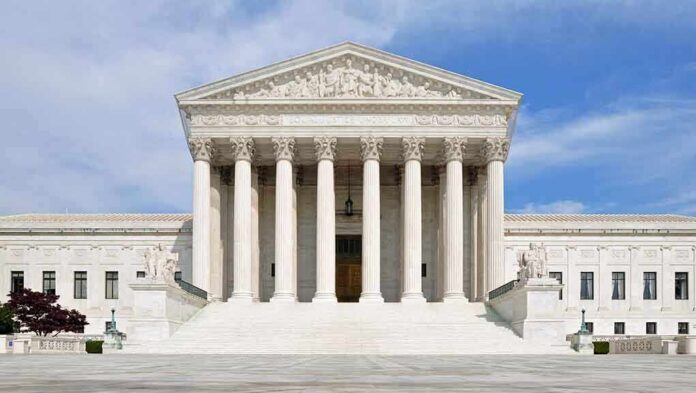
The Supreme Court’s twin immigration rulings hand Washington more power while leaving millions to wonder who, if anyone, is guarding their rights.
Story Snapshot
- The Court approved ending Temporary Protected Status for Haitians and Syrians in a 6-3 decision [5].
- A second 6-3 ruling backed a border “metering” approach that blocks asylum before entry [21].
- Dissenting justices warned the decisions defy Congress’s humanitarian goals and risk lives [11].
- The outcomes fit a longer trend of the Court favoring executive control when Congress stalls [22].
What the Court Decided and Why It Matters
Six justices ruled the administration can move to end Temporary Protected Status for Haitian and Syrian nationals. The majority said the immigration statute limits courts from hearing non-constitutional challenges to that decision. That narrows the paths to block policy changes and speeds executive action [5]. A separate 6-3 ruling backed a border “metering” rule. People at the line, but not admitted, cannot seek asylum under this reading of the law. The Department of Homeland Security signaled support for the outcome [1].
The two rulings together expand federal control at key choke points. Ending protection for long-settled families shifts risk onto workers, employers, and local schools. Reviving metering changes the first contact at the border, which may push people into more dangerous crossings. Supporters say the rulings restore order and follow the text of the law. Critics say the decisions gut Congress’s promises and ignore on-the-ground harm [21].
How the Majority and Dissents Framed the Law
The majority focused on statutory text and limits on court review. In the Temporary Protected Status case, the opinion read the statute to bar many legal claims, leaving policy choices to the executive branch unless a constitutional issue is raised [5]. In the metering case, the majority read “arrival” to require entry into the country before asylum can be requested. That definition drew a sharp line at the border line itself [21].
Justice Elena Kagan’s dissent argued that the record includes statements by President Trump that show racial bias toward Haitians, which should matter when reviewing the Temporary Protected Status decision [11]. Justice Sonia Sotomayor dissented from the bench in the metering case and cited specific cases of assault and death among people turned back, warning that the ruling invites more tragedy. She argued Congress passed the Refugee Act to stop the very harms the majority now permits [11].
The Bigger Picture: Power Shifts When Congress Stalls
These cases track a larger pattern in immigration law. When Congress fails to update complex rules, courts often defer to the executive branch or the agency that enforces the law. Over many cases, that has shifted more power to presidents of both parties and trimmed back broad court orders from trial judges. Advocates call this a slow erosion of humanitarian protections. Backers call it faithful reading of law as written, not as wished [22].
**1/5**
The Supreme Court handed down a 6-3 win for the rule of law on June 25, 2026, green-lighting the end of TPS for 350,000+ Haitians and 6,000 Syrians. Activist judges and past administrations had twisted this temporary program into permanent residency through repeated… https://t.co/EfOjTXmzFT— My name is Meg (@TrixieVespa) June 26, 2026
The rulings also feed public distrust. Many Americans see leaders in both parties talk tough and dodge fixes. Business owners want a stable workforce. Border towns want safety and clear rules. Families inside the system want a fair process. The Court’s textual focus may be sound in law, yet it leaves real people in limbo. That gap between courtroom logic and street reality is where anger at “the system” grows [5].
What Changes Next and What to Watch
Policy officials can now accelerate plans to end Temporary Protected Status designations and apply metering at ports. States, cities, and employers will feel the change first as work permits lapse and families face removal. Expect new lawsuits that raise constitutional claims and fresh requests for records that probe the stated reasons for these moves. Watch Congress. If lawmakers want different outcomes, they must revise the statutes and set clear guardrails for border processing and protected status [22].
Sources:
[1] Web – Supreme Court issues two big wins for Trump’s immigration policy
[5] Web – Supreme Court Allows Trump Administration to Circumvent District …
[11] Web – Trump Scores 2 Major Immigration Wins in Latest Supreme Court Rulings
[21] Web – [PDF] REPORT ON THE TRUMP ADMINISTRATION’S 2025 CHANGES …
[22] Web – 100 days of immigration under the second Trump administration